Seasonal Mystery Hunting: What to Look for in Cemeteries in Autumn
Autumn is the season when a cemetery stops being a backdrop and becomes a document. The sun sits lower, leaves come off the lime and beech, undergrowth dies back, and the parts of the ground you walked past in July — a kerb sinking into turf, a shallow inscription, the ghost of a name surviving in lead letters while the stone around it has gone — are suddenly right in front of you. What follows is a field guide to what deserves a second look, and the order in which to look at it.
Start with the light, not the stones
Carving is a landscape in miniature, and like any landscape it needs raking light to show its relief. At midday in June, the sun is high enough that a worn inscription flattens into a pale slab. In October and November the light arrives at a low angle for most of the day, and every incised letter casts a thin shadow along its edge.
Two habits will change what you find. First, walk a row with the sun to your side rather than behind you or in front; sidelight is what lifts letterforms out of the surface. Second, carry a small torch even in daylight. Hold it almost parallel to the face of a stone — grazing the surface from the side — and inscriptions that looked blank will often resolve into names, dates, and a line or two of verse.
Weather matters as much as hour. Wet stone darkens and holds contrast well, so a damp morning after rain is excellent for reading. Frost is better still: it settles into joints, cracks, and tool marks, briefly drawing the mason's work in white. Overcast light is the most honest for photography, low sun the most revealing for the eye. They are not the same job.
Read the weathering before you read the words
Stone type tells you what to expect, and what to expect tells you where to look.
Soft stone and hard stone
Marble and the softer sandstones tend to "sugar" — the surface granulates and edges round off, so lettering loses its sharpness first at the top of the stone and last near the base, where rain runs off less. Slate and the harder igneous stones hold crisp edges for a very long time, which is why a slate slab can still read cleanly after a marble neighbour has gone soft. Limestone in industrial or coastal areas often shows dark staining and pitting, and its surface can be dissolved away by decades of rain.
Lead letters and the ghost effect
Many nineteenth-century monuments used lead inserts for the lettering. The metal survives while the stone around it erodes, so you get raised letters floating on a recessed face, sometimes almost free of the stone. This is one of the great pleasures of autumn hunting: a name lit from the side, standing a few millimetres proud of nothing.
Lean, sink and split
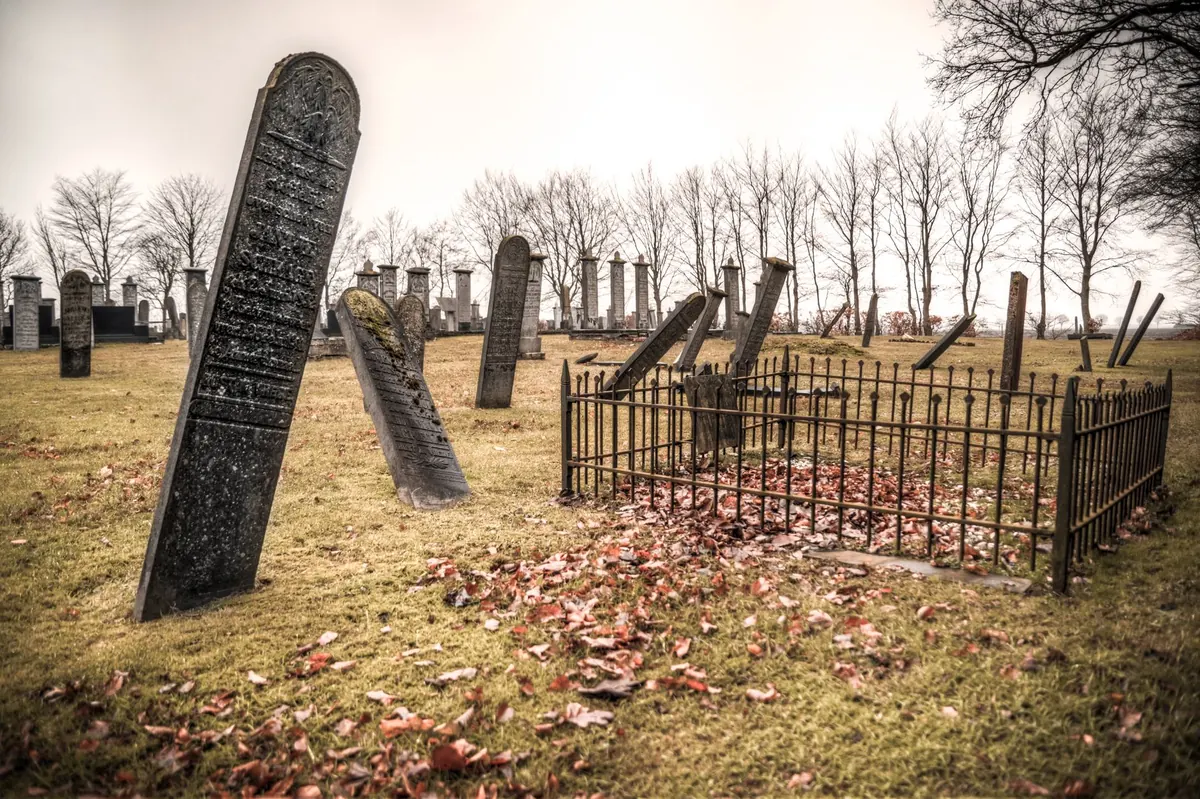
Stand back and look at the whole stone. A lean usually means ground movement rather than vandalism; a split often follows a bedding plane or a frost crack; a kerb that has sunk to grass level tells you the plot has settled. Stones re-used or turned around are not uncommon, and a face with the lettering upside down or absent on one side is worth a slow walk around.
Symbolism reads differently in low sun
Carved symbols are shallow relief, which means they respond to sidelight even more than lettering does. A draped urn in flat noon looks like a lump; in October light the folds separate and you can see whether the drapery is carved or merely moulded.
These are conventions rather than a code — families chose what they chose, and meanings shifted by region and decade — but the common vocabulary is worth knowing:
- Draped urn — mourning; the fabric marks the monument as a container of grief.
- Broken column — conventionally read as a life cut short.
- Willow — grief and mourning, very common in the nineteenth century.
- Ivy — fidelity and memory; it also climbs and hides, which is a different problem.
- Clasped hands — farewell, or reunion, depending on which hand is which and who is reading.
- Downward torch — a life extinguished; an upright torch means the opposite.
- Lamb — usually a child's grave.
- Sheaf of wheat — a long life, gathered in.
- Anchor — hope, though it can equally mark a seafaring life.
- Pointing hand — direction, usually upward.
- Open book — a life recorded, or cut off mid-page.
Older grounds sometimes carry winged skulls and soul effigies, the earlier mortality symbols that gave way to urns and willows in the nineteenth century. If you see both in one churchyard, you are probably looking at two different generations of the same family plot.
Inscription details most people walk past
Once the name is legible, the small words around it are where the real reading begins. Look at the letterforms themselves: Roman capitals, Gothic revival blackletter, and flowing scripts each point to a period and a fashion. Look at the abbreviations, too. "Relict" means widow; "consort" indicates a spouse; "AE" or "aet." stands for aetatis, "at the age of". A stone that reads "who departed this life" belongs to a different tradition from one that reads "in loving memory", and the change is usually gradual rather than sudden.
Autumn is a good time to notice re-cutting. On family stones, later names were often added years after the first burial, and the second hand is visible: slightly different spacing, a different depth of cut, a change in the style of numerals. Look for gaps left in the layout — a blank space beneath a husband's name that was later filled, or never was. And check the dates carefully; a weathered "3" and an "8" are easily confused, and the only reliable check is the spacing and the surviving tool marks.
The ground itself is a layer of evidence
When the undergrowth dies back, the shape of a plot appears. Leaf litter collects in hollows, which marks sunken graves without any need to probe. Curbs and footstones emerge from grass that had swallowed them by June. Ivy, at its greenest after rain against fading grass, is easy to follow — and worth following, because ivy both marks the boundaries of old plots and slowly prises joints apart.
Planting is evidence too. Yew, holly, and snowdrop clumps often survive long after the family has stopped visiting. Gravel paths, iron railings, and low kerbs show where a plot was once maintained. None of this tells you a story on its own; all of it helps you decide which stones are worth a second visit.
A workable method for one afternoon
- Walk the perimeter first. Get the layout, the date range, and the direction of the light before you kneel anywhere.
- Choose one block. A dozen stones read properly beat a hundred photographed badly.
- Circle each stone on foot. All four sides, then step back five metres and look again.
- Note before you photograph. Write what you can see, then record it; the camera will lose the faint detail your eye caught.
- Graze the light. Torch at a low angle across the face for anything illegible at noon.
- Record your uncertainties honestly. A question mark beside a doubtful letter is more useful later than a confident guess.
Before you go: etiquette, kit and timing
Cemeteries are working places as well as historical ones. Check opening hours before you set out, because many close at dusk and autumn dusk arrives early. Give way and stay quiet if a funeral is in progress or a family is visiting. Do not move or lean on unstable stones, and do not lift plantings to see what is beneath them.
A few items make the afternoon easier: a soft brush for loose debris (never wire, never a scraper), a torch, a notebook and pencil, gloves, and a kneeling pad for wet ground. If you want to try a rubbing, keep it to sound slate or hard stone, use a soft pencil and light pressure, and check the cemetery's rules first — many sites prohibit the practice outright because it damages fragile surfaces. Metal detecting is generally forbidden in cemeteries and often unlawful, so leave the equipment at home.
What autumn really gives you is permission to slow down. The light is doing half the work, the ground is clearing itself, and the stones are as legible as they will be all year. Take one row at a time, and let the season do the rest.
Photo: ClickerHappy / Pexels