A Beginner's Guide to Decoding Symbols in Church Architecture
You step into a village church on a wet afternoon, shake out your umbrella, and look up. Above the door there is a stern figure in stone with a hand raised. On the font, something with scales is coiled around the base. In the east window, a woman in blue stands beside a wheel. None of it is random, and almost none of it is as mysterious as the internet would like you to believe. Learning to read a church is mostly a matter of knowing what to look for, in what order, and when to stop.
Why There Is So Much to Read
For most of the medieval period, the majority of people who entered a church could not read Latin, and many could not read at all. Preaching and liturgy did the heavy teaching, but carved stone and painted glass gave people something to look at, remember and point out to a child. That is why a parish church can feel like a picture book in which the pages have been rearranged several times over eight centuries.
Here is the first thing a beginner should internalise: symbols are not a code with fixed answers. A lion could stand for Christ, for the Evangelist Mark, for courage, or for a local lord's family. Meaning shifted with region, century and the person who paid for the carving. Treat any tidy dictionary of church symbols as a starting point, never as a verdict.
Start With the Plan, Not the Detail
Before you examine a single capital, stand at the west end and look east. Most traditional churches are oriented so the altar sits at the sunrise end, a habit inherited from early Christian practice and read as a reference to Christ as light. The main body you are standing in is the nave — from navis, ship — and the narrower area around the altar is the chancel.
Where transepts cross the nave, the building forms a Latin cross in plan, with the arms pointing north and south. That shape is symbolic, but it is also practical: transepts add space and support a central tower. Many small churches are simply two rectangles end to end, and later aisles, porches and vestries distort the original shape. Ask what was there in 1300 and what was bolted on in 1860; the difference matters constantly.
Three things to check in the first five minutes
- The date. Look for a noticeboard, a guide leaflet or a datestone. Norman, Decorated, Perpendicular and Victorian Gothic each have their own habits, and misreading the period is the most common beginner's error.
- The oldest walls. Often the tower, the chancel arch or the north wall, which saw less rebuilding.
- What is original. Fonts, doorways and roofs survive; glass, pews and reredoses frequently do not.
Numbers and Shapes
Three, four, seven, twelve
Numbers carry the clearest and most consistent meanings. Three points to the Trinity, which is why so many windows are divided into three lights and so many towers have three stages. Four suggests the created world and the four Evangelists: a square crossing, a quatrefoil, four corners. Seven combines the two and appears in seven-branch candlesticks and seven sacraments. Twelve — apostles, tribes of Israel — shows up in the twelve columns of a chapter house or the twelve niches of a reredos.
Circles, squares, octagons
A circle suggests eternity, having no beginning and no end; a square suggests the earth and stability. The octagon is the shape to watch. Eight is the day after the Sabbath, the day of resurrection, which is why baptisteries and fonts are so often eight-sided: baptism as entry into new life. This is one of the few symbolic readings you can apply with reasonable confidence, and it will make you look clever in front of a font without actually being wrong.
The Doorway Is the Front Page
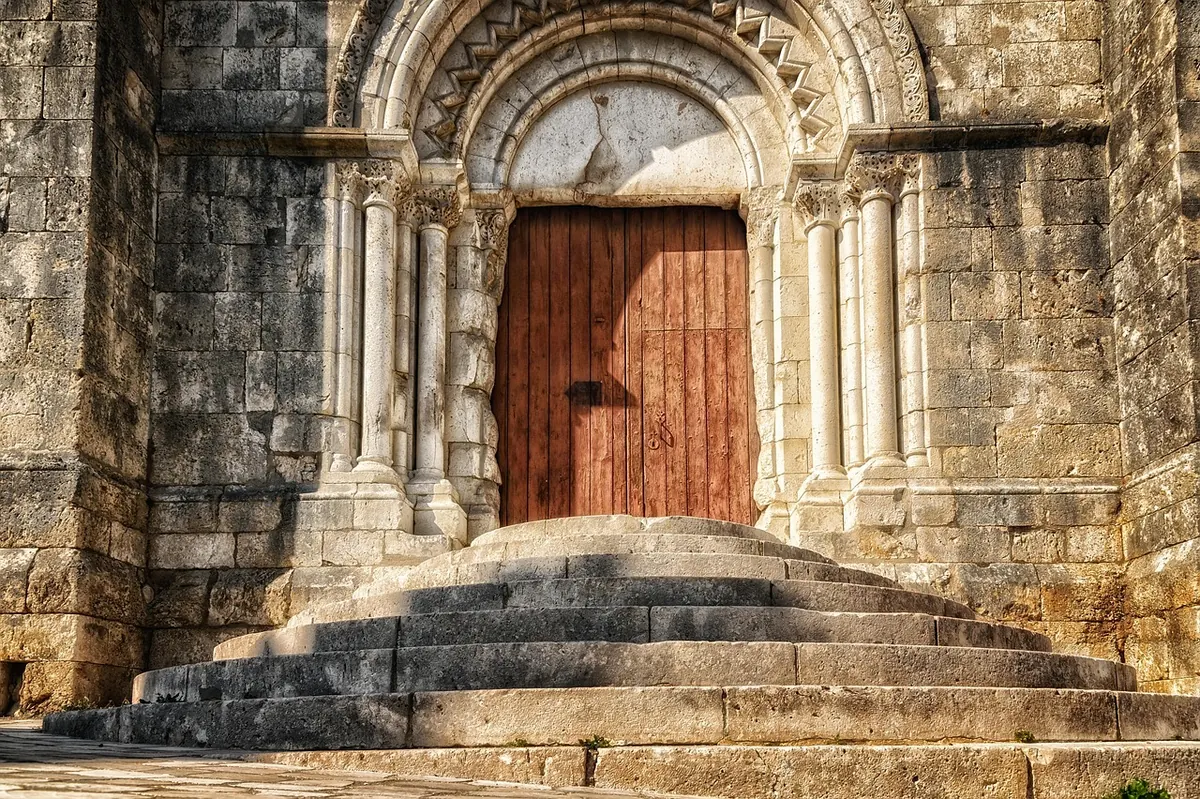
In a Romanesque or Gothic church, the main portal carries the most concentrated programme of sculpture in the building. The semicircular panel above the doors is the tympanum; the bands of arches around it are archivolts; the standing figures at the sides are on the jambs. Read the centre first. A figure seated in a mandorla — an almond-shaped frame — with one hand raised is usually Christ in majesty. Below, in a Last Judgment scene, you may find souls being weighed, the blessed being led away, and the damned in a very bad mood.
Work outward and downward. Archivolts often hold angels, prophets, seasons or Labours of the Months; jambs may hold apostles or local saints. Look for small everyday details — a mason with a mallet, a pedlar with a pack — because these are the human touches that make a thirteenth-century doorway worth twenty minutes rather than twenty seconds.
Animals, Plants and the Green Man
Medieval bestiaries gave animals moral personalities, and carvers used them freely. The lamb stands for Christ; the dove for the Holy Spirit or peace; the eagle, said to stare at the sun, for the Ascension and for John. The pelican feeding its young from its own breast is a popular legend, not scripture, and it appears on fonts and tombs as a symbol of self-sacrifice. The lion was thought to wake its cubs after three days. The serpent is usually the enemy, but bite its own tail and it becomes eternity.
Plants are quieter and often more reliable. A vine with grapes points to the Eucharist; a lily to purity; oak leaves and acorns to endurance or simply to a good local carver. The foliate head known as the Green Man is everywhere in English churches, and the claim that it is a surviving pagan god is repeated far more often than it is evidenced. In most cases it is a confident piece of decoration. Enjoy it as carving first, symbol second.
Rule of thumb: if a feature could reasonably be explained by drainage, seating, lighting or fashion, try that explanation before you try theology.
Glass, Colour and Light
Gothic builders thinned their walls to make room for windows, and the theology followed: light as a sign of the divine. Rose windows are usually organised around a centre — a figure of Christ or the Virgin — with radiating panels that are best identified from the innermost ring outward. Colour carries meaning: gold for the heavenly, red for blood and martyrs, blue strongly associated with the Virgin from the twelfth century onward. Blue glass was expensive, so its presence often signals a wealthy patron rather than a hidden message.
The caveat is large. Much medieval glass in Britain was destroyed in the sixteenth and seventeenth centuries, and nineteenth-century restorers installed their own palettes and their own favourite saints. A blue robe may tell you more about 1865 than about 1265.
How Not to Overinterpret
The pleasure of church-watching is spoiled by people who insist everything means something. Decorative carving was often just decorative; masons had apprentices, budgets and leftover stone. Some features are structural: a squint is a hole to see the altar from a side aisle, a rood stair is a staircase to a lost screen, buttresses are holding the wall up. Some marks are masons' signatures, not secret glyphs. Some imagery is heraldry — a patron's family, initials, a date — and the story it tells is about money and status.
A short checklist before you announce a discovery
- Date the feature, not just the building.
- Look for repetition. A motif used once, in an odd corner, is weak evidence.
- Check for a structural or practical explanation.
- Look for heraldry and initials nearby.
- Compare with neighbouring churches of the same period; local workshops had house styles.
- Be sceptical of any claim that requires a secret tradition to explain it.
A Field Guide for Your First Visit
Go with one question, not ten. Walk the plan from west to east, then return to the door and read the sculpture outward. Photograph details you do not understand — the font base, the corbel table, the glass — and look them up afterwards, when you can compare them with published descriptions of that specific building. Buy the guidebook; the best ones are written by people who have spent years in the archive. Ask the welcomer what they would show a visitor, and note the answer.
Keep a small notebook and write down three things per church: the date, one detail you can identify, and one you cannot. After a dozen buildings, you will start recognising the same animals, the same numbers, the same doorway arrangement, and the reading becomes easier with every visit. Leave room, always, for the possibility that a strange face on a capital is simply a mason enjoying himself.
Photo: Tama66 / Pixabay